
Building a Culture of Evidence-Based Product Decisions
Creating the research infrastructure that scaled user insight across nCino's global PDE organization
Executive Summary
I built nCino's global UX research system from the ground up, transforming fragmented and inconsistent discovery work into a unified capability used by 90 product designers and product managers across the organization. The system connects with a verified panel of over 310,000 users and has enabled 3,752 research sessions, producing 445 strategic insights that directly inform product decisions, roadmap priorities, and measurable business goals.
Collectively, the system reflects more than 3,430 hours of direct user engagement and has supported 250 projects spanning multiple product lines. With an annual investment of approximately $75K, the system continues to scale globally and remains a durable foundation for evidence-based decision making at nCino.
There's never enough budget to hire every role an organization needs. So I stepped up. For nearly four years, I held the role of UX Research Lead in addition to my responsibilities as an individual contributor and later as a design manager. The system now runs without me. That's how I know it works.
This was my approach:
1
How I built the case for research in a compliance-heavy environment and earned executive sign-off.
2
How I created a 310,000-person research panel and deployed the tools that made research accessible.
3
How I trained 90 researchers, integrated AI into our workflows, and built a self-sustaining capability.

The boardroom moment
This wasn't a problem I could solve with a clever workaround. The compliance implications were significant enough that I needed executive alignment at the highest level.
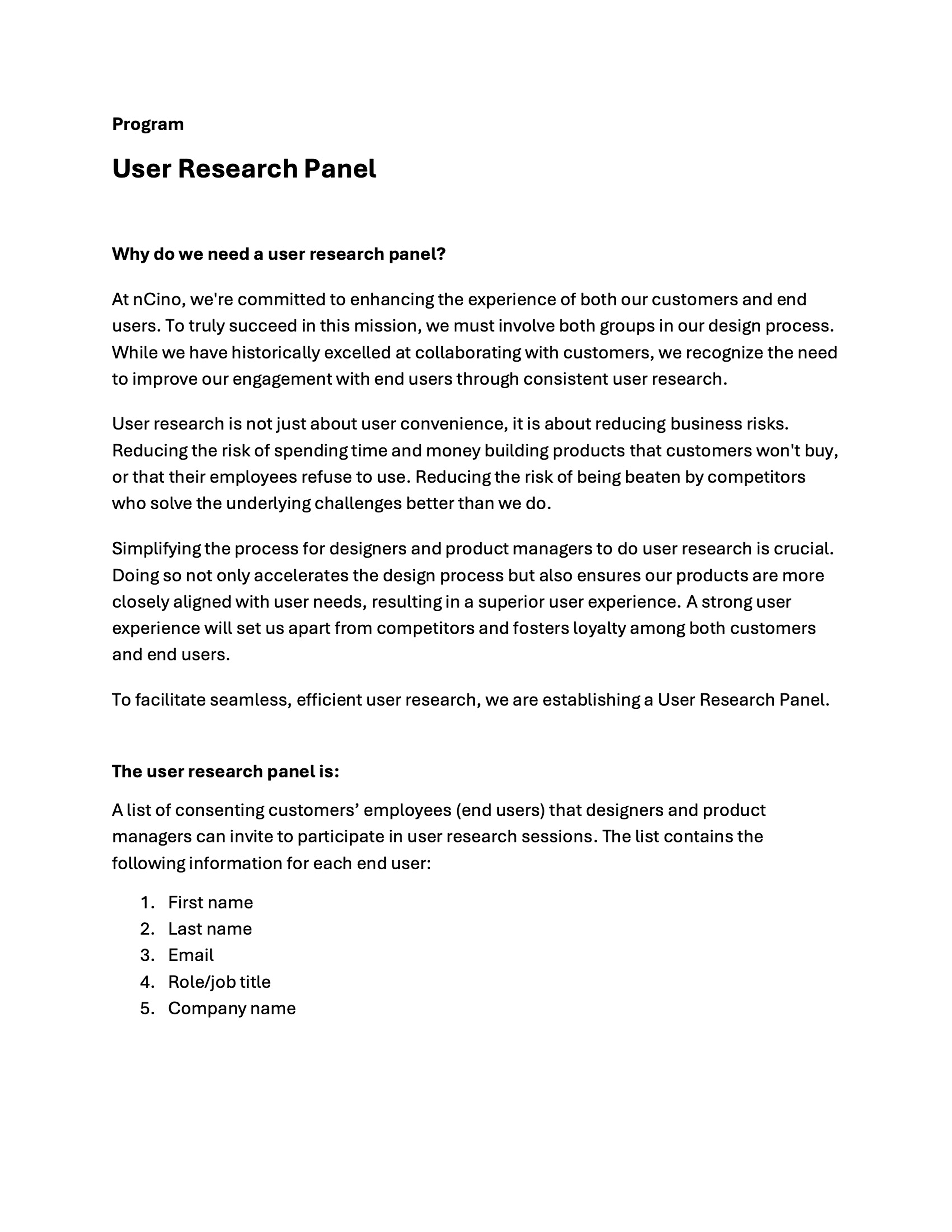
I built a business case outlining the cost of unvalidated design decisions and the organizational risks of continuing without a formal system. I presented it to our UX Director first, then prepared for the real test: presenting to the CEO, the entire C-suite, and nCino's Data Governance Council.
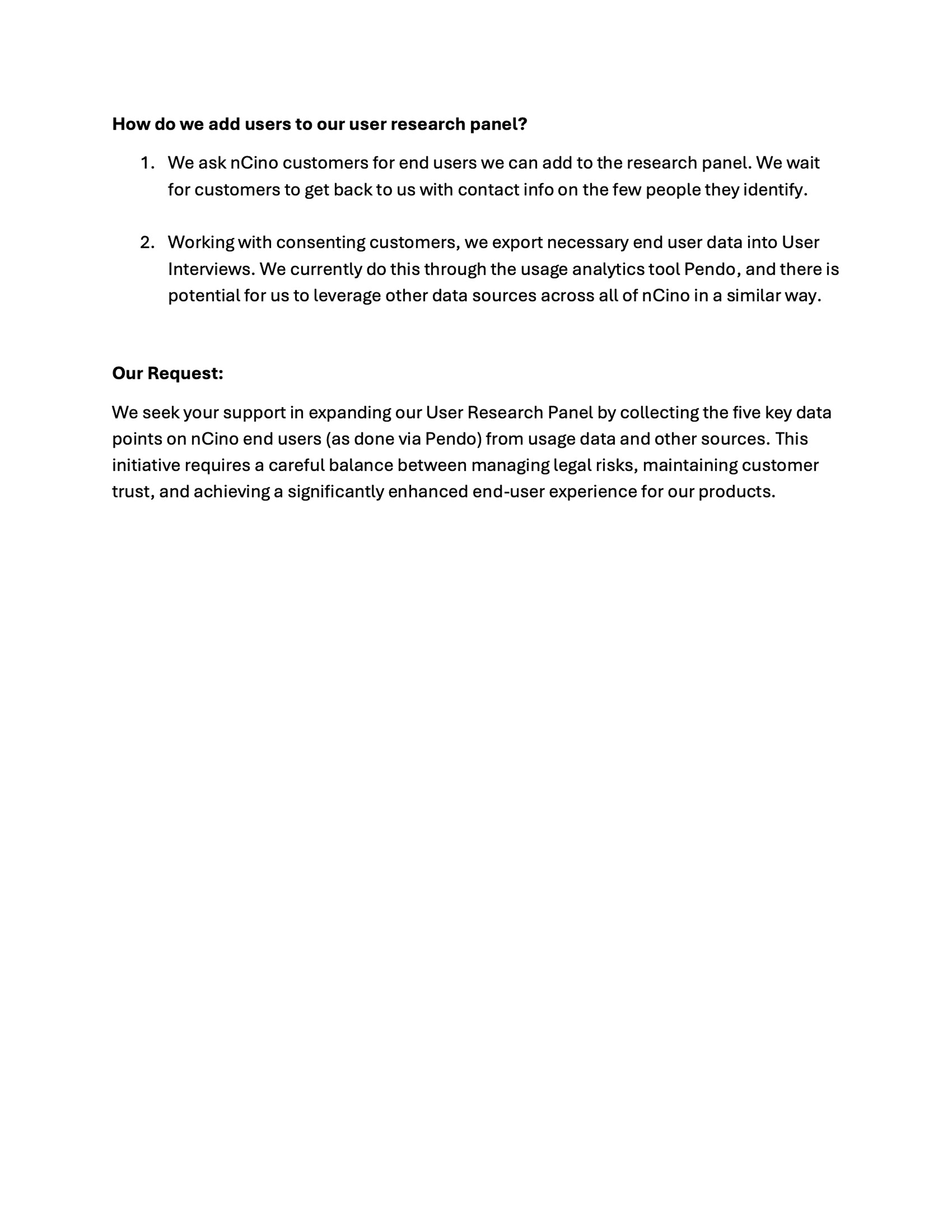
This took weeks of planning. I chose to run the meeting Amazon boardroom style. I brought physical paper copies of a short, two-page document and began the meeting by asking the entire room to stop everything and simply read the document in its entirety. No slides. No distractions. Just the argument on paper.
The document made the case clearly: without a compliant and scalable approach, we couldn't safely learn from the people using our products. The stakes were too high, and the opportunity cost of flying blind was even higher. Simplifying the process for designers and product managers to conduct user research would accelerate our design process and ensure our products aligned more closely with user needs, setting us apart from competitors.
They approved it. That meeting remains a defining moment in my career.
Here's where it gets interesting
From Spreadsheets to Systems 🔧
Starting with listening
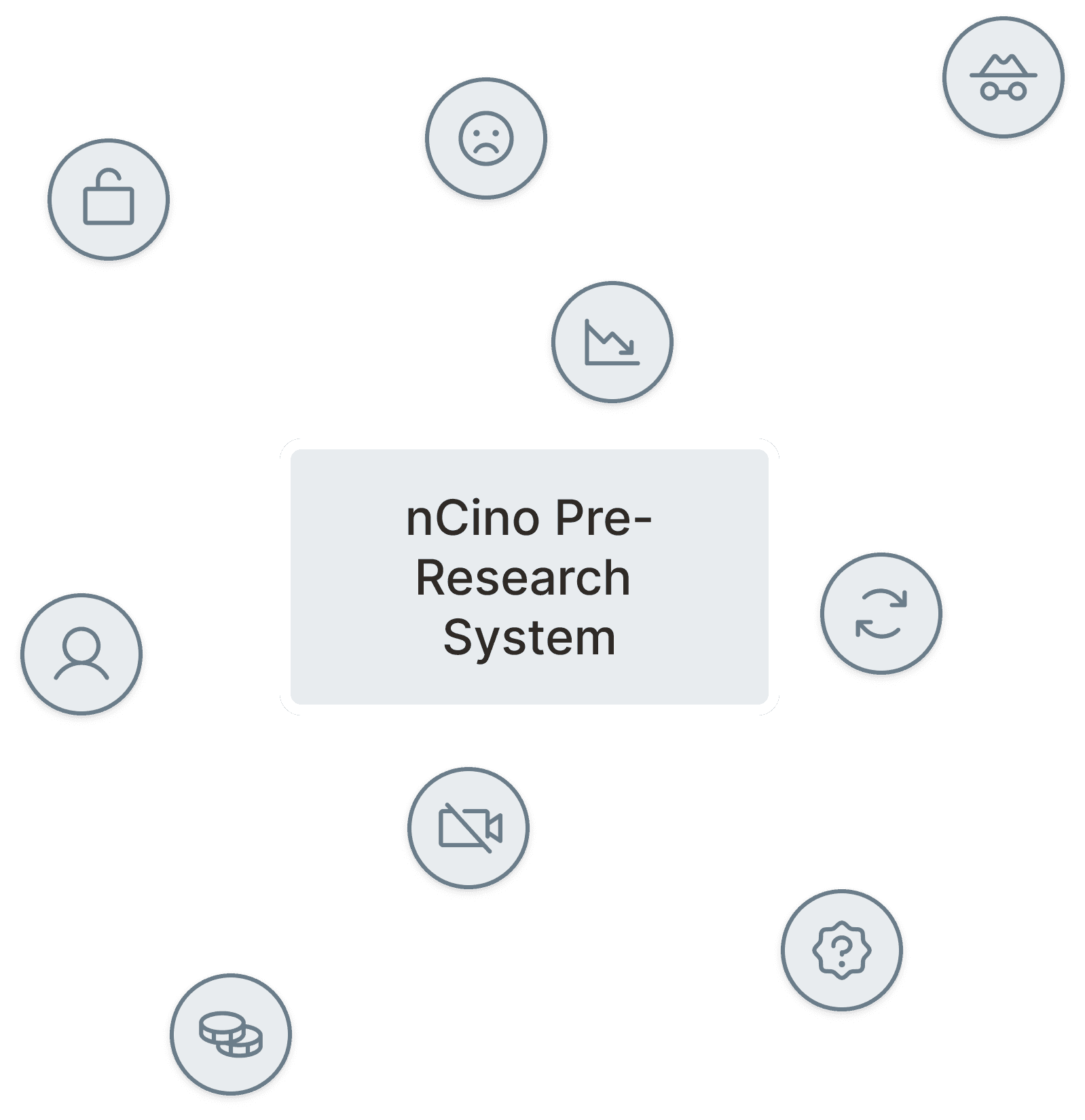
Before proposing solutions, I met with designers across the organization to understand how they attempted research, what slowed them down, and where they needed support. Nearly everyone described the same pain points: difficulty recruiting users, unclear compliance expectations, fragmented tools, and no centralized place to learn from past studies.
Using these interviews, I mapped the end-to-end research process and identified the systemic gaps blocking scale. Three needs emerged clearly: a compliant process for recruiting and engaging real users, a single system of record for storing and synthesizing research, and a repeatable workflow that any designer or PM could confidently run.
Selecting the right tools
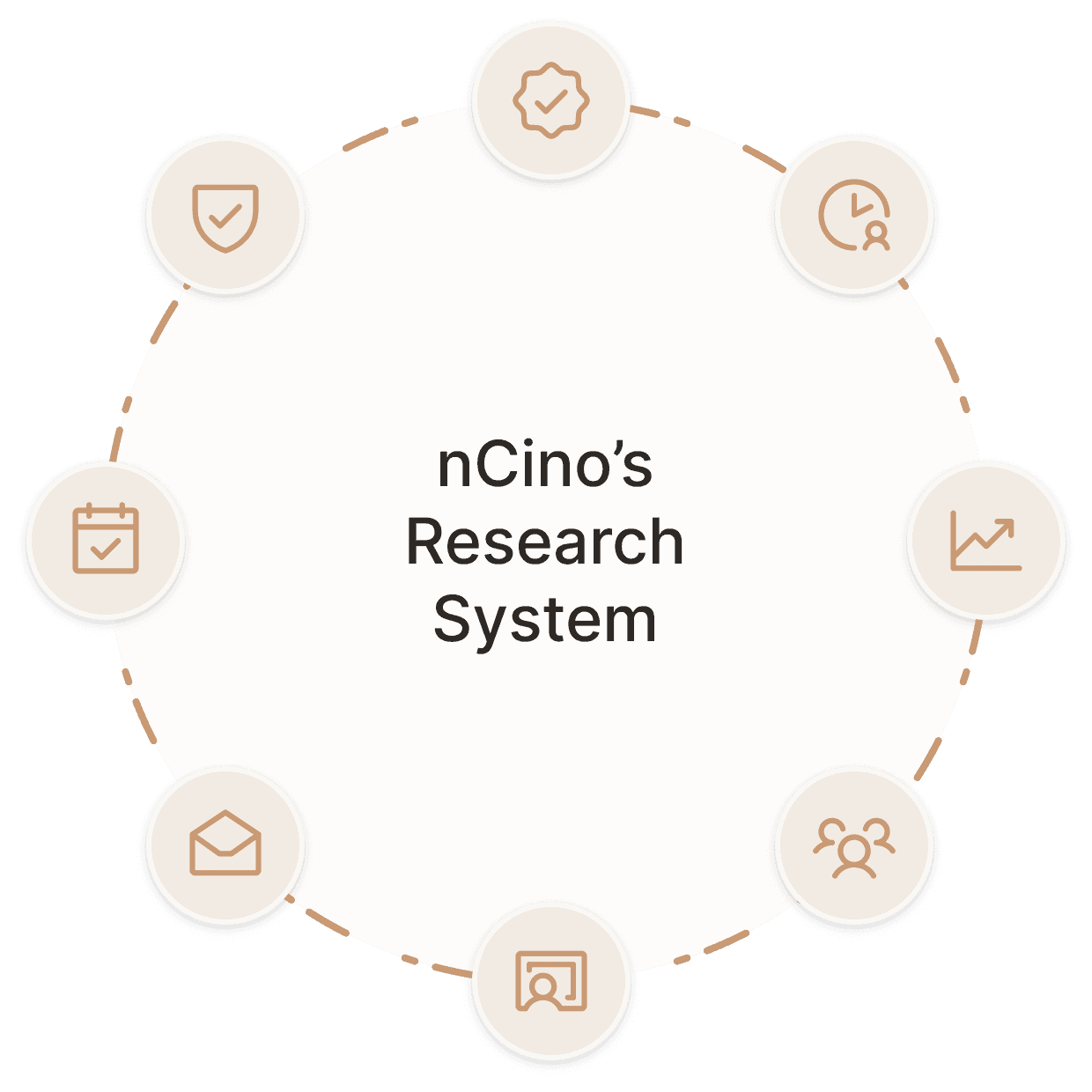
I implemented two core platforms: User Interviews for participant recruitment and scheduling, and Dovetail for centralized storage, synthesis, and insight management.
I partnered closely with Legal, Security, and Customer Success to develop compliant outreach guidelines, consent processes, and data handling workflows that respected financial regulations. These guardrails allowed designers and PMs to engage users safely without needing specialized knowledge of every restriction.
Within days, the first studies were running under the new system.
Building a research panel from nothing
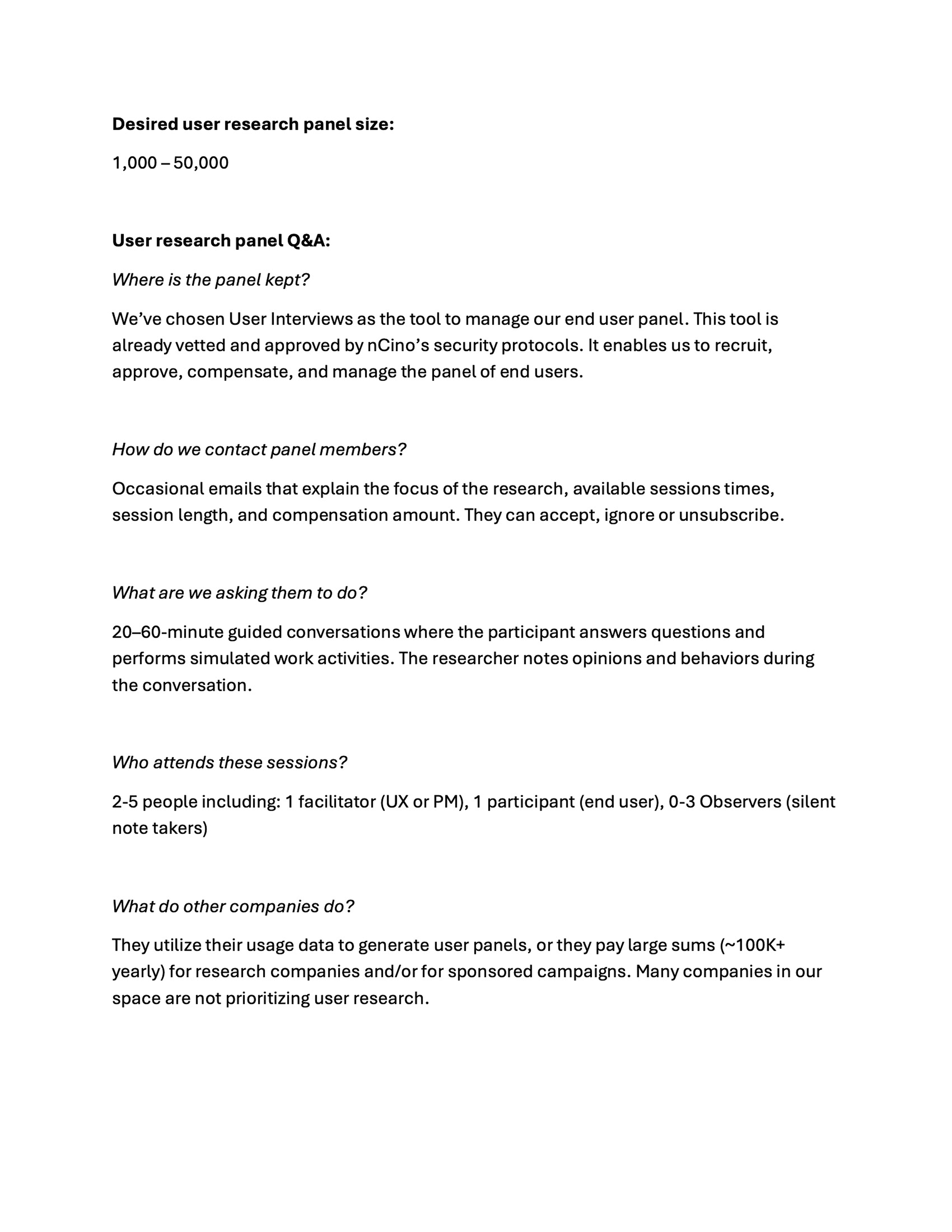
Our single largest challenge was finding the right users to research with. In B2B fintech, you can't just post on social media and expect to have qualified candidates show up. I spearheaded an effort to build nCino's first-ever user research panel, collaborating across nearly every department: Legal, Customer Success, Product, Sales, Security, and Engineering.
The barriers were significant. Personally identifiable information (PII) was a core concern from Legal. Data privacy requirements, customer relationship sensitivities, and regulatory constraints all had to be addressed. But one by one, we solved them.
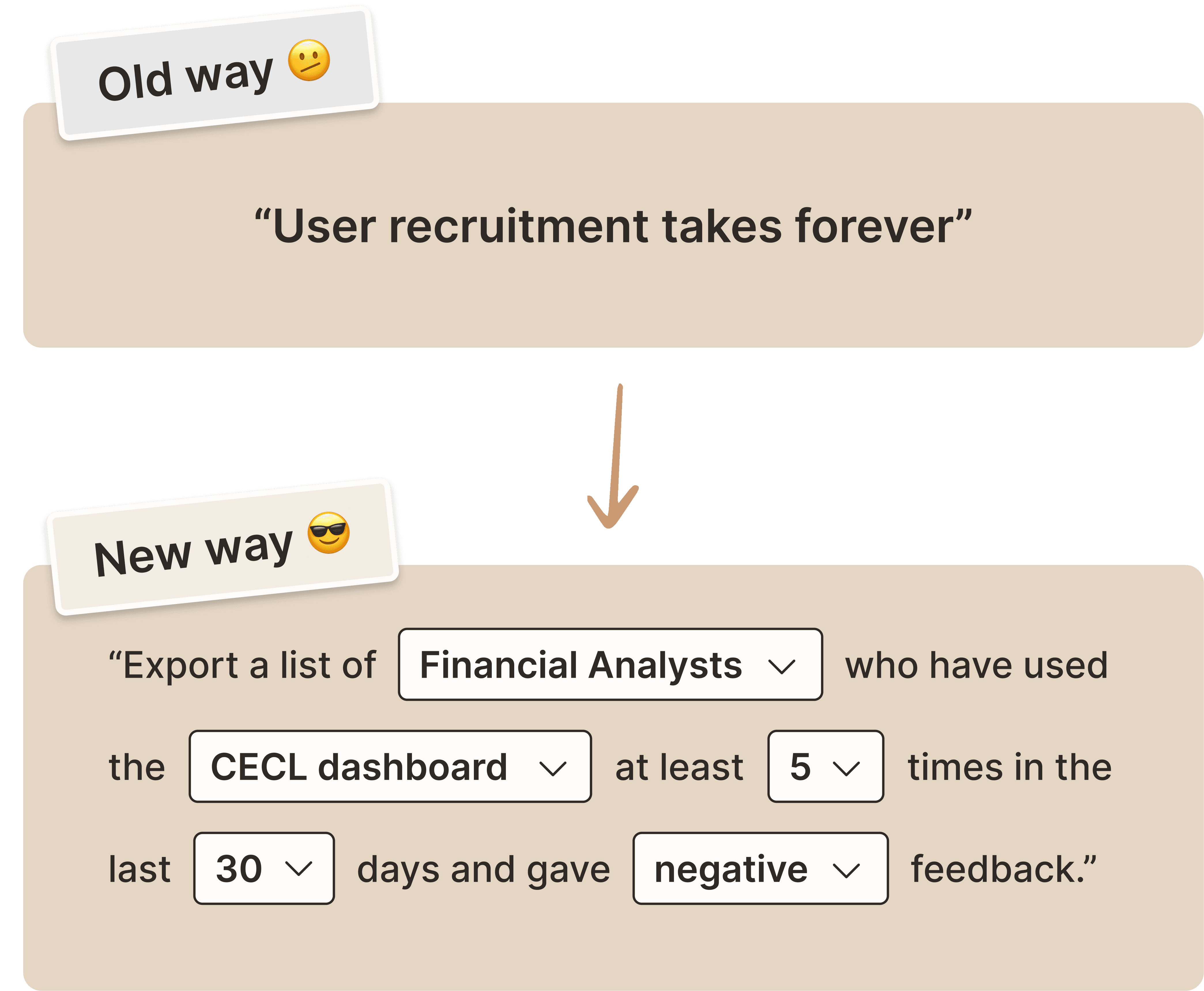
This panel transformed how nCino approaches user research. Teams that previously struggled to find a single participant can now recruit representative users in days instead of weeks. It remains one of the most impactful pieces of infrastructure I've built in my career.
This is where it all came together
Research Becomes Culture 🌱
Making research a team habit
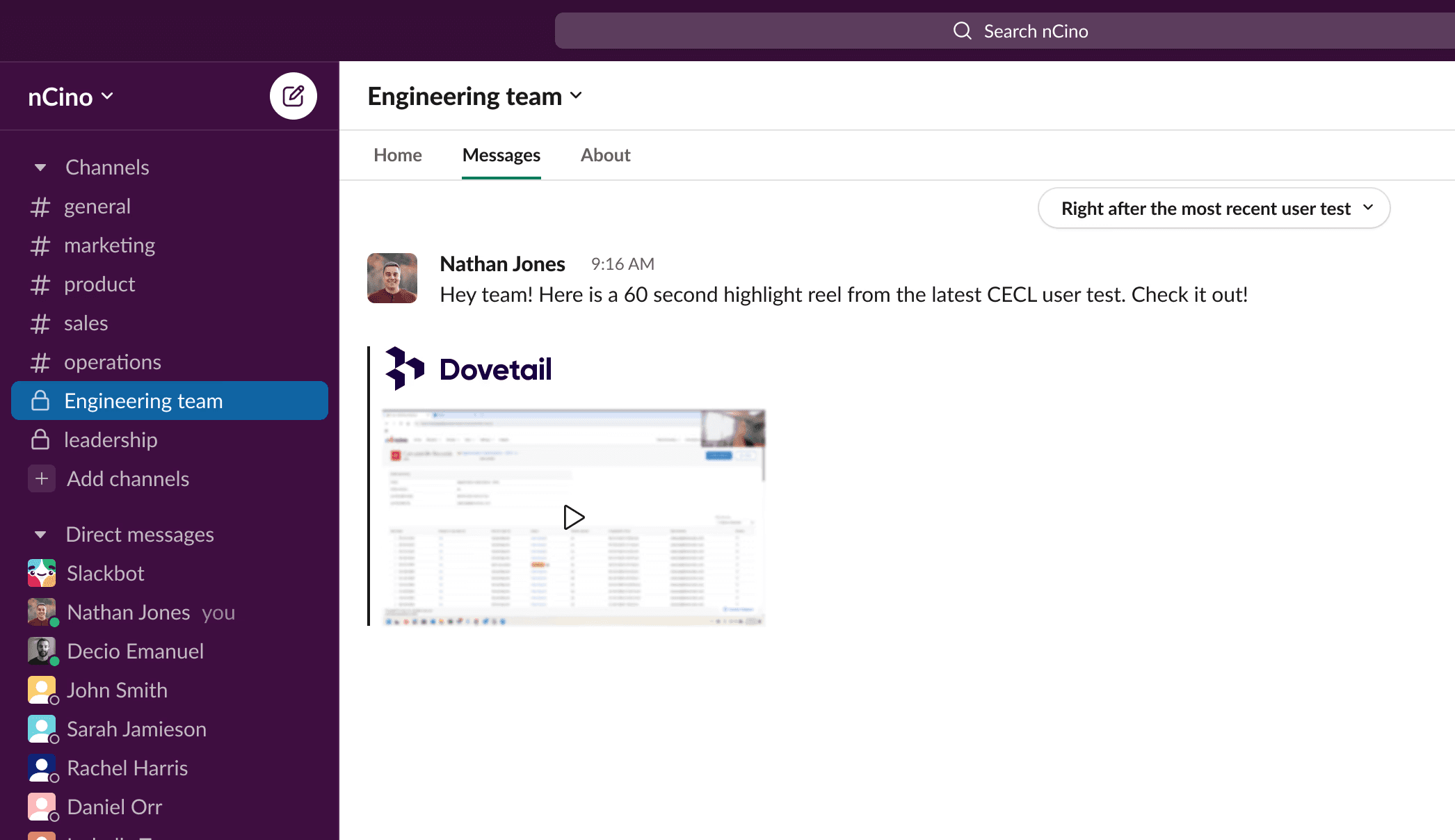
Many engineers (and even some designers and product managers) were initially skeptical. To change that, I began sharing short "tik-tok style" video clips from user sessions in team slack channels. Seeing a real person struggle to complete a task had far more impact than any summary could.
Participation grew quickly. Engineers started joining live sessions, asking questions, and using what they learned to refine features before handoff. Research stopped being viewed as a design function and became a shared discipline that guided how we built and prioritized work.
I led ongoing training sessions, developed onboarding materials, created standardized templates, and held office hours to accelerate adoption. The team learned by doing. Designers shared results in real time, improved processes collaboratively, and began to see research as part of their craft rather than a specialized function.
Integrating AI to accelerate insight
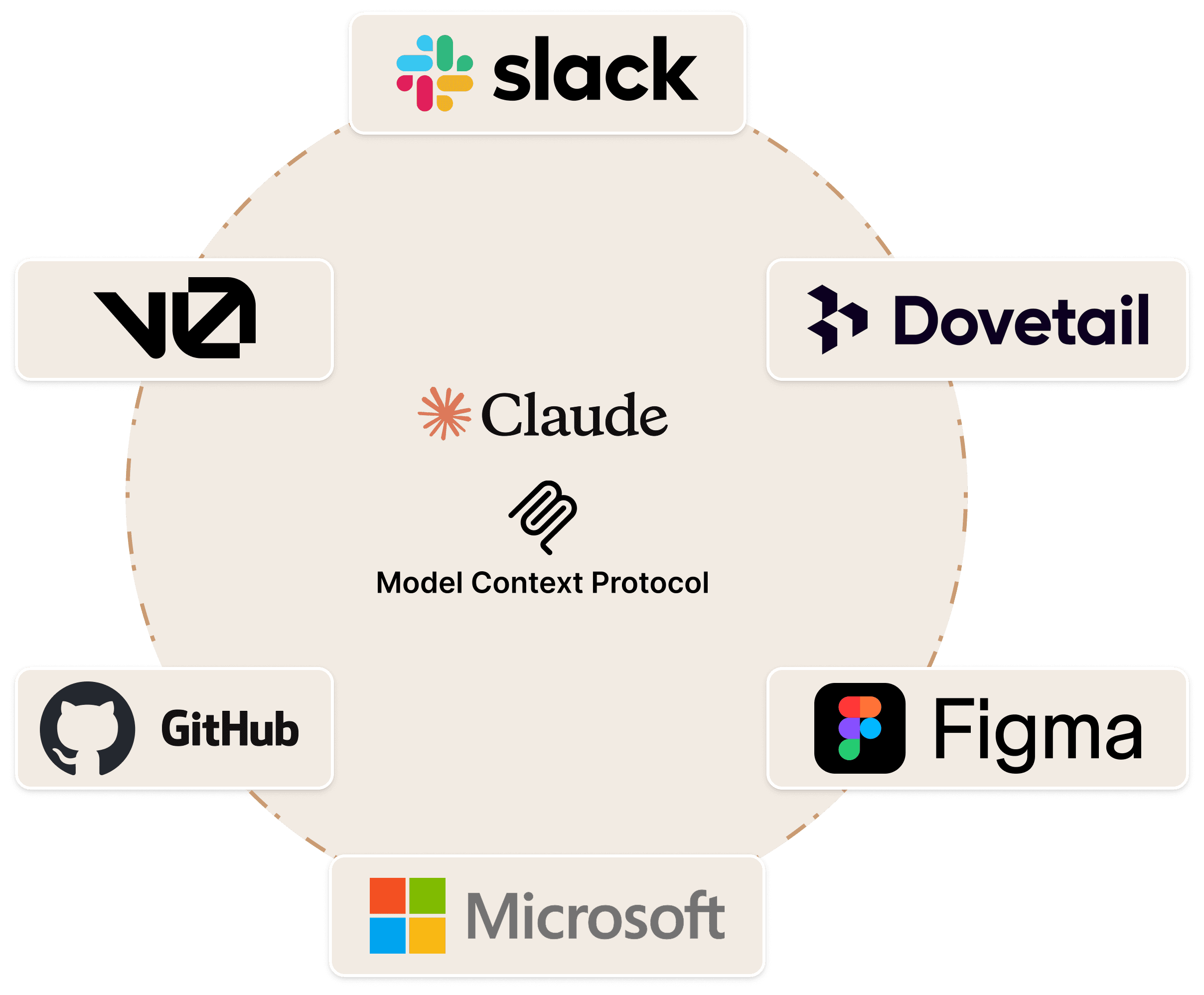
As the practice matured, I introduced AI-assisted synthesis through Dovetail's MCP connection with Claude. This wasn't about replacing human understanding. It was about removing the manual overhead that slowed teams down.
The impact was significant. Researchers can now summarize transcripts, identify patterns, and generate structured reports in a fraction of the time. What used to take hours now takes minutes. Speed increased dramatically while quality improved at the same time.
The AI handles busywork. Humans stay focused on observation, empathy, and the insight that only comes from watching real people interact with our products.
Connecting research to delivery
We centralized findings in Dovetail and connected them directly to Jira and product planning workflows. Every decision can now be traced back to a real user moment. Insights directly influence roadmap prioritization, and teams validate assumptions earlier to reduce delivery risk.
Research is no longer a support activity at nCino. It is a strategic engine for reducing the risk of building the wrong thing.
Progress is great, but outcomes matter more.
Results and Impact 📈
Over four years, the research system fundamentally changed how nCino learns from users and how product decisions are made. What began as fragmented effort is now a global, unified capability that scales across teams and functions.
3,752
Research sessions completed
445
Trackable insights
250
Projects supported
3,430 Hours
of direct user engagement
90
Designers & PM's enabled
310K
Research panel participants
Consistently Positive
Participant feedback
~$75K
Annual investment
4 years
From zero to scale
Reflection
The goal was never just to run more studies. It was to reduce business risk by grounding every decision in real user evidence.
The real challenge was navigating a complex regulatory environment where every decision required careful coordination across Legal, Security, and executive leadership. In B2B fintech, compliance isn't a checkbox. It's the foundation everything else rests on. Standing in that boardroom, asking the CEO and C-suite to read my document in silence, was proof that user research could be done responsibly in one of the most regulated industries in software.
Four years later, what makes me proudest is not the number of sessions or the tools we deployed, but the lasting shift in behavior. Across continents and product lines, teams now approach problems with curiosity and align decisions to real user needs.
The question is no longer "should we talk to users?" It's "what's the next big idea we can validate so we ship with confidence?" 🚀
Want to hear more? Reach out!
nathanwesjones@gmail.com
Role
User Research Lead
Industry
Fintech
Time frame
September 2021 - Present
Impact
3,694 research sessions completed
Follow